Showing posts with label #roundtheworld. Show all posts

Tuesday, September 29, 2015

Point Yacht Club elects their Flag Officers


Point Yacht Club
Flag Officers
Durban: Tuesday 7 September

The Point Yacht Club has a new helmsman, Round the World sailor; Craig Millar has been elected as the new Commodore for the Durban based yacht club.

With an extensive competitive sailing CV; Millar has numerous awards, both in South Africa and internationally competing in Hunters, J22 and Solings. His most triumphant sailing achievement would be when he was the skipper for the Durban entry in the 2005/2006 Clipper Round the World yacht race, where together with his crew they came second overall.


“It is a great honour to be bestowed with the title of Commodore. I sincerely hope to share and grow the phenomenal sport of sailing, and encourage more people to come and be a part of it.” encouraged, Millar.

Second in Command, Kevin Bingham will fill the role of Vice Commodore, Millar’s right hand man. Bingham has earned his stripes being a frequent Race Officer for dinghy racing most Saturday afternoons either in the bay or offshore. His CV boasts SASCOC Protea Colours for Sailing Management, Optimist World Champs team manager when they travelled to New Zealand in 2011; Past Chairman for SAS KZN and Past President for the SA Optimist Sailing Class and to round it off; he is a recognised SAS Provincial Race Officer as well.


“I am extremely lucky to be supported by a man of Kevin’s calibre as well as the experienced and highly competent team of Rear Commodores.” concluded Millar.

Joining him will be Myles White, who is in charge of the smaller boats and takes the role of Dinghy Rear Commodore. White has over 4 decades experience sailing in Durban, preferring the exhilaration of racing in his Flying Fifteen. White has experience in all aspects of sailing, having competed in long distance racing, round the cans racing, and more recently favouring dinghy racing.


“After something like 40 years of membership I have now completed my first year on any Club Committee, and I am looking forward to applying some of the lessons I learned through Round Table and hopefully building on the recent success achieved in dinghy sailing at PYC. My objective is to get more boats on the water more regularly and for people to have so much fun doing it that they keep coming back for more.” enthused an optimistic White at the announcement.


Ron Pet will be looking after the larger yachts with his title of Keeler Rear Commodore; Pet’s love for the bigger yachts is evident with the amount of time he puts in as race officer on Wednesday night’s Twilight Racing and weekend offshore racing. Pet also is the hardworking man behind the scenes for the hugely popular MSC Week.


Retaining his position, Nik Albert stays on as the Youth Rear Commodore. Albert is a keen competitor himself in both the Hobie and Flying Fifteen classes. The keen Durban sailor has had a successful term with a number of youngsters coming up through the ranks, representing both Point Yacht Club and South Africa at a variety of events and Albert hopes to grow this.

Point Yacht Club has a fine team at the helm for the next cycle, with the recently elected Flag Officers starting to get into the groove of growing the sport of sailing in Durban.


For more info visit www.pyc.co.za

Friday, March 7, 2014

Chatting to Nqoba Mswazi before he joins the Clipper Round The World Yacht Race

Royal Natal Yacht Club
Nqoba Mswazi


Durban’s yacht club, the Royal Natal Yacht Club bids a fond farewell to young Nqoba Mswazi as he heads off to Qingdao in China to compete in the Clipper Round the World Yacht Race.

The accomplished sailor who grew up in Umgababa flies out to the port of Qingdao on the east coast of China to join the fleet of 12 Clippers that are currently sailing around the world. Mswazi will be racing on one leg in the tenth race of the Clipper Round the World Yacht Race that will take about four or five weeks to sail to San Francisco.  He is one of the more experienced crew members on the yacht, Invest Africa.


Mswazi, a regular sailing personality nicknamed ‘The Machine’, competes in all of the local races offshore of Durban and has only sailed in two international races prior to his upcoming Pacific crossing. He competed in the Colorpress Vasco da Gama Race from Maputo to Durban last year and early on his sailing career he raced in the Round Creole Island Race in Reunion.


“My first international race I competed in Reunion, my mentor Sean Jones and I competed in a class that we knew little about but learnt a lot. It was the F18 class, a big hobie cat, we came third last but my passion for sailing ignited there.”

Asked what he is most nervous about his upcoming adventure, he quickly states, “The cold!”


Pic by Trevor Wilkins
Having just turned 21, he celebrated this milestone in Portsmouth when he was there for his Clipper Training. Mswazi certainly has a bright future ahead of him in the sport of sailing.

The Rear Commodore for the Royal Natal Yacht Club, Rob Samways said, “We wish Nqoba well, he will grow in leaps and bounds with this opportunity. I personally am looking forward to his return as he will be crewing on our yacht Sticky Fingers in this year’s Vasco da Gama Race. His fresh experience will work wonders for us.”


The tough 5,800 nautical mile race begins on Sunday 16 March and is a monster of a leg. Once leaving the safety of the port, the clippers will be weaving around local fishing boats offshore of China battling with the renowned fog that hovers off the coastline of China. The cold winter conditions will challenge the fleets in the first week at sea as snow will be a regular feature on the decks.


Mswazi and his team will have to read the weather carefully as they cross the largest ocean in the world. Will they sail close to the rhumb line, the shortest route that you can sail and run the risk of light winds or head north for a colder but stronger ride east.


Invest Africa’s estimated arrival is around 15 April, “I am looking forward to the privilege of sailing under the Golden Gate Bridge. The sailors that I have spoken to have talked highly about the feeling that you get gliding underneath it, the magical sight of San Francisco coming into focus after weeks at sea.” Mswazi concluded.

Royal Natal Yacht Club’s Nqoba Mswazi is going places as he tackles the upcoming Clipper Round the World Yacht Race leg from Qingdao to San Francisco.

For more info on the race, visit http://www.clipperroundtheworld.com/ or visit the Royal Natal Yacht Club site www.rnyc.org.za


Monday, September 23, 2013

Chatting to sailor Michael Dickinson

Royal Natal Yacht Club
Michael Dickinson


There is an ocean of possibilities awaiting Glenwood High’s Michael Dickinson as he prepares for the most prestigious sailing event in the country, the Ola Lipton Challenge Cup.

On the eve of his eighteenth birthday, the young man enthuses, “I started sailing with my father when I was eight years old, and I always enjoyed water sports so kept at it.”


The Glenwood High School student is extremely passionate about sailing with his bucket list consisting all of nautical to-do items, “I am hoping to get my yacht masters, compete in the 49er youth worlds, sail in a Velux 5 Oceans, oh and of course pass matric! My list gets longer and longer, but the basic aim is to sail, sail and sail some more.”

Gearing up for the biggest sailing event in the country, Dickinson comments, “The preparations have been tough with a limited budget to get the yacht up to standard and we have an inexperienced team, we have a lot of work to do. That being said, the guys have been great taking it in their stride and always having a blast, always finding a way to laugh. And the teamwork has been out of this world.”


“The whole team is really looking forward to the competition and learning something new!” the young skipper adds. The team is one of the youngest that will be competing, with an average age of 15 years and all being Glenwood learners.

Dickinson recently was awarded the Choose Life Youth Trophy when he competed in the Colorpress Vasco da Gama international yacht race, the race that started in Maputo and finished in Durban this May. “The best memory would have to be as we were coming in and watching Choose Life Pacer come across our bow at the finish line making us realise how close the race was.”


This would be the highlight of his fledgling career,” I have been to a few places mainly in the UK and a few others for racing but nothing beats sailing offshore here at home.”

“I am a sailor because I love its challenges and no one race is ever the same. My motto is to keep sailing and go extremely fast, there isn’t anything like it! The thrill of flying across the water is a huge adrenaline rush, as well as sailing is really physical and keeps you fit.” said the enthusiastic lad.


His interest off the water has him eyeing out the bulls eye. “I dabble in a bit of archery, the discipline involved is fantastic and you have to work hard to hit your target! A good life lesson.”

The matric student plans to pursue his love to the ocean, “I am hoping to study something in the field of Maritime Studies and maybe something in journalism as well!”


But for now, the sailor spends every waking moment on the water, “I pretty much sail every day after school; I enjoy sharing my passion and coach Terra's introducing other people to the great sport.”

All local eyes are on the lads from Glenwood High School, representing the youngest yacht club in the country, the Glenwood High School Yacht Club, Dickinson is joined by Gabriel Davies; Rowan Garrat; Joshua Canaan; Brendan Humphries and Eli Brophy-Tintinger.


Monday, May 27, 2013

Wrap up for the Coopers Lighthouse There-and-Back Race


Royal Natal Yacht Club
Coopers Lighthouse There-And –Back Race
Sunday 26 May

The trimaran Ladybird skippered by Andrew Dolloway dominated in Sunday’s Royal Natal Yacht Club Coopers Lighthouse There-and-Back Race taking line honours in a fleet of 17.


Dolloway led from the onset heading offshore on the run as he raced to the mark set furthest for the racing class. Being the first boat to turn around the buoy, he opted for the route closest to the shore as he worked his way up to the finish line in a magnificent time of just over two hours.


Second around the racing pin, Sticky Fingers with Rob Samways at the helm navigated his way down the centre of the course. On his approach, Sticky Fingers caught up with the first in the cruising class, Bellissima with James Goss steering the larger yacht. The two duelled their way to the finish line in a wonderful tussle for the honour of second across the finish line. Bellissima powered her way to the end, pipping Sticky Fingers at the post.


James Goss enthusiastically stated after the race, “That was exciting! We were within inches of Sticky Fingers. I opted to wait and head further offshore on our approach to the finish with our final tack taking us perfectly through the line. This tactic worked fantastically and I am so pleased with our result!”


The wind filled the sails just in time for the race officer, Greg Challis to set the cluster of yachts off on time with one start for all the sailors. A gentle 5knots and glassy waters greeted the sailors as they set off flying their spinnakers sailing down to two marks just off Coopers Lighthouse off the Bluff.  The slower, bigger boats in the Cruising Class turned first with the racing classes buoy further down the coast allowing them to stretch their legs and power their way around the course.


On the beat back to the finish, the north easterly got to around 8knots giving the boats a bit more power. The entire fleet finished within one hour after the leader Ladybird with only one yacht retiring. The Durban sailors were treated to a once in a lifetime backdrop as they made their way back to the finish line near the harbour mouth, three Dutch Tall Ships departed Durban continuing their circumnavigation with the next stop in Port Louis in Mauritius made for a welcome and memorable sight.


Ahead of the biggest sailing event in South Africa, four L26s used the race to get some hard earned time on the water for the upcoming Lipton Challenge with the two big contenders finish first and fifth on handicap in the racing class.


Results
Cruising Class
1 Bellissima (James Goss), 2 Caversham Caprice (Richard Crockett), 3 So Basic (Stuart Ritchie), 4 Inside Out (Phil Downing) 5 Cest La Vie DNF
Racing Class
1 Choose Life Coordination (Richard Weddell), 2 Sticky Fingers (Rob Samways), 3 Aquavit (Ross McGill), 4 Majimoto (Jon Marshall), 5 Orion B2G2 (Patrick Harris), 6 Zing (Gavin Smith), 7 Therapy (Gavin Wadsworth), 8 Choose Life Element (Siya Vato), 9 Container World (Michael Dickinson), 10 Flyer (Brad Rayson), 11 Zap (Graham Rose)
Multihull
1 Ladybird (Andrew Dolloway)


Wednesday, December 5, 2012

Round the World Sailor, Ralf Dominick talks about the Northwest Passage

Imvubu meaning Hippo going through the Northwest Passage and meeting a local. Cartoon done by Lawrence Moorcroft from the Bluff Yacht Club


Royal Natal Yacht Club hosted Ralf Dominick recently where he shared tales to a packed room of sailors

Going to listen to the charming Ralf Dominick, you are in danger of acquiring a few stamps in your passport when he passionately shares tales of his circumnavigation on his yacht Imvubu.

Commodore for the Royal Natal Yacht Club, Richard Crockett, introduced the intrepid traveller as a free spirit, setting sail with no real plan of where he was going.

Manihi Atoll


Dominick stood before us smiling, explaining, “I am going to leave out the tropics as many of you here this evening have sailed in parts of it and a number of you here have sailed in company with Imvubu so you would know if I am exaggerating or lying.”

Continuing with a twinkle in his eye, he commented, “I am going to concentrate on the journey through the Northwest Passage, and it is not because I am boasting being one of only about 150 transits through this passage, but because no one here will know if I am exaggerating slightly.”

Dominick launched Imvubu on the 19 June 2009 at the Bluff Yacht Club, he chuckles, “I got my own back at the truck drivers. I blocked the road for half a day as she was craned from the yard onto a truck and transported to the launch site.”

Departing Durban on 2 January 2010, he sailed south to Cape Town where he packed up his boat with supplies for heading across the Atlantic. Waving goodbye to family, he left Cape Town on 21 February 2010.

Having spent close on a year cruising through the magnificent Caribbean islands, with Imvubu spending three months on the hard staying safe during the hurricane season, Dominick headed north. At the end of April they made their way up the East coast of America with the goal of making it through the magical Northwest Passage.

They stopped in at Washington DC, sailing right into the heart of the capital. Exploring the cultural melting pot that is the capital, Dominick stumbled upon the Rolling Thunder Rally that has a quarter of a million Harley Davidsons cruising through the capital. “After three hours, after watching thousands of HOGs go by, I left, mainly because I had a headache from the noise!”


Next was a stop in New York City, “Since 9/11 I found the residents to be a lot kinder than in previous visits.” he stated happily.


“One of the best naval museums I have ever visited was located at my next stop, in Mystic Seaport located on the Mystic River. They have over 35 boats on display including an 1820 whaling ship. The Charles W. Morgan is the only surviving wooden whaling ship in America. It was a treat to visit.”


At Portland, on the coast of Maine, gearing up for the expected freezing conditions further north, another 20,000BTU of heating was added to the 5,500BTU already installed on Imvubu.

From the USA East Coast the journey continued on to Nova Scotia, Canada and onwards to Newfoundland. “A number of the small towns are slowly dying due to the moratorium on Cod fishing. In fact during the 1950’s the government had a forced resettlement program to consolidate many of these settlement. Most adults now work on the oil fields in Alberta while the youth are moving south where life is a lot easier, so in some places it felt like a ghost town.”

Gros Morne National Park Newfoundland Canada


“I sailed through a fjord that was 200m wide and was experiencing the worst fog for many years. In the gaps we managed to see the sheer cliffs that surrounded us with tumbling waterfalls cascading into the cold water. Yet another exquisite memory!”


Ralf's favourite pic of an Iceberg. He didn't dare get to near it in-case he dislodged some of the ice.
While in Newfoundland Dominick made the decision to commit himself and his crew to the Northwest Passage:  “I must say, it was the case of right place, right time, right boat and the crew was solid!”

Newfounland Huge Fjord


In 1497, the first recorded expedition to find the mythical Northwest Passage, was undertaken by John Cabot. For the next three centuries there were many expeditions to locate this passage. During the Napoleonic wars the quest for the passage waned. However in 1819, due to reports by whalers that the ice was retreating, interest in finding the passage was renewed. The most famous failure was in 1845 when Sir John Franklin, with his two vessels the Terror and the Erebus, failed to return. Subsequent relief expeditions, launched at the behest of Lady Franklin to determine the fate of John Franklin, are credited with having discovered an impractical ice bound passage by dog sled. John Rae, an employee of the Hudson Bay Company, while on a dog sled expedition in this area is now generally credited with having discovered a navigable passage through the Franklin Strait into the Beaufort Sea.

The first vessel to actually transit the North West from Arctic Circle to Arctic Circle was Roald Amundsen in 1903. The next transit was some forty years later by a Canadian Police cutter skippered by Henry Larsen. By the end of the 2010 season the Scott Polar Research Institute at University of Cambridge had recorded 143 transits by 99 different vessel.

Dominick was approximately the 150th entry into the esteemed list that completed a transit from Arctic Circle to Arctic Circle through the Northwest Passage. Imvubu was the first South African Vessel to have completed the transit.

In 2011, the window of opportunity was better than previous years as the temperatures and ice seemed a lot kinder than in previous years, giving Imvubu and Dominick a gap of six weeks to make it through.

Dominick stopped off at St John, Newfoundland, the last significant town before getting to the other side of the world, to prepare the vessel for what lay ahead.  “There are many details to be considered such as a solution for preventing the engine cooling water intakes from freezing, preventing condensation from forming on windows, provisions for a year and of course charts for the region.”

“You might have heard of St John, the wreck of the Titanic lies some 600km south east of this town. The distress call from the Titanic was picked up at Cape Race, 140km south of St John's, where the Canadian Marconi company had built a station eight years earlier.”

“Before departing St John, I went to collect our charts that I had ordered but they hadn’t arrived. The charts were a vital ingredient for the next leg. We needed the charts! The owner of the company promised me that at the next stop at Cartwright in Labrador, he would have the charts there; they would be at the small airport. We got to the airport a few days later and went to meet the plane, but there was nothing. The pilot defensively even suggested we search the plane, there really were no charts. I contacted the airline and found that the plane that they were on had been diverted due to the weather. So asking around I found a lady who lived in the town where the plane was and her brother was unemployed, so he got in the car and drove the charts up, a return trip of 16 hours. Arriving at 1am, we gave him a cup of coffee, a thousand dollars and then sent him on his way a few hours later.”

The plan was to sail 2,000 miles northwards before turning westwards into Lancaster Sound, which marks the start of the actual passage. A 100 miles south of the turning point they sailed past a tender floating upside down. “It didn’t sit right as it clearly belonged to a yacht and there weren’t too many yachts around so we pulled it on board and contacted the coast guard. “The coastguard requested that we divert to Pond Inlet, a small hamlet in the high Arctic, to deliver the salvaged tender so that they could investigate its origins”.

Meeting the Coast Guard, meant that the planed route altered slightly with a dogleg  down to Pond Inlet, the coast guard on the other hand made sure that there was sufficient diesel fuel available for Imvubu.

On 20 August the direction altered for the first time in ten days, with Imvubu now following a path in a westerly direction. On 24 August, the South African vessel reached her highest point north, with the co-ordinates of 74°19’N, the wind was averaging 40knots and the temperature was 2.5°C.

They turned down to Cambridge Bay where they anchored to refuel. While they were ancored in the bay, Eskimos were shooting at Narwhals, small whales with a single tusk or the mystical unicorn whales. “It was a surreal Wild West situation, after refuelling with 500 litres of jet fuel, the only fuel they had in Cambridge Bay we were at anchor and had bullets whistling past us. It didn’t look like the locals were effective hunters as the bullets were almost hitting us and not the whales!”


The next encounter Dominick had with the locals was at the next settlement of Tuktoyaktuk as a guest at the local school, “I was invited to the school when the new teaches were being introduced. On one of the walls there was a huge sign in English advertising that they should eat more whales because they were good for you! The sign went into great details, talking about the fat content and what it did for you! Fascinating reading.”

Continuing, “This is where I tried whale blubber; I have to admit it wasn’t very tasty. Somewhat how one would imagine it to taste like!”, “a local Inuit hunter however gave me two freshly bagged brown speckled geese, that made a superb potjie”.

The door started slamming on the adventurer, with the pack ice moving in. He made his way through the Bering Strait sailing between Russia and across the way, the tip of America, leaving behind the Arctic Circle.  He made it to Nome, Alaska surfing in in early September, 164 miles from Siberia and just under 2,000miles from the North Pole. Nome is renowned for gold mining and Dominick met a man who generously gave him two nuggets as mementos from Alaska.


A sign post in Nome, Alaska


“I read in the Nome Times that when the cartographer was mapping the area, they hadn’t named the Cape so he simply wrote ‘? name’ down on the map. When the maps got back to the United Kingdom, the chap officially drawing them up read it as C. Nome which promptly became Cape Nome and the name stuck and that is how it has stayed!”

“Crossing the Bering sea we got hammered although it could have been much worse and made it into the safety of False Pass in the Aleutian Islands with hours to spare before the next big storm system arrived”.

When the weather cleared Imvubu pushed on, passing steaming volcanoes, “There are 36 active volcanoes in Alaska, the most anywhere in the world located in one country! As we were sailing on a relatively calm day through the Kupreanof Straits a rocket launch took place from the Kodiak Space Centre on the other side of Kodiak Island”.

The intrepid traveller sat out yet more bad weather in Yakutat Bay on the eastern side of the Gulf of Alaska, here he joined another yacht that had also transited the North West Passage and the two of them waited through gale force winds. “We followed a number of fishing vessels heading out but encountered an unexpected low pressure system with storm force winds and mountainous seas, clearly we didn’t go very far and turned around and ran for shelter.”

“In desperation I spoke to the met guys and their response was that they were unable to forecast the weather because every few hours the weather was changing dramatically.”

In the early hours of the next morning there was a slight break in the weather and Dominick decided this was the gap. Saying a quick goodbye to this fellow yachtsman, who was not at all convinced that there was a break, he left the dock and sailed further down the coast, escaping the weather in a few more coves but made it into the safety of the Alaskan Inside Passage.

“When I arrived at Juneau Alaska I could celebrate as I had made it through the Northwest Passage and got out of the high latitudes before winter set in!  Although I was now through the worst I knew there was still a hard slog ahead to make my way down the North American west coast in winter.”

“My friend got stuck in Yakutat for a further three weeks and by the time he got into the Inside Passage the season was too far advanced and he had to give up and spend the winter at Sitka.”

Showing us a number of gorgeous images, he pauses stating, “Of the thousands of photos that I took on the trip, this is my favourite. Blackstone Glacier was just exquisite.”


Asked if he was ever scared, he smiles, “I used to fly jets for fifteen years so going from a sport of flying at a speed of six miles a minute to sailing  six miles an hour, I would think I coped under the pressures that arose. And I have to say that the boat was superb in all the conditions!”


Concluding he questions, “Doesn’t anyone want to know about the fishing and the fish? The places I visited were not only picturesque but heavenly on the taste buds. I ate like royalty, everything from crayfish to salmon to cod. You name it, I sampled it. I would have to say my best fish would have to be Arctic Char which was just delectable.” 


Imvubu is currently being prepared for her next odyssey when he plans to head down south to Antarctica and then up the east coast of South America before crossing to Europe However, he is plotting to return to Alaska… in summer and not with his boat.

The inspiring story of Ralf Dominick’s lifelong dream to circumnavigate the globe plants seeds for those with itchy feet and a desire to travel to a number of incredible options that lie waiting to be discovered.

Friday, November 9, 2012

RNYC Sailor of the Year returns to Durban


Royal Natal Yacht Club
RNYC Sailor of the Year returns to Durban
Round the World


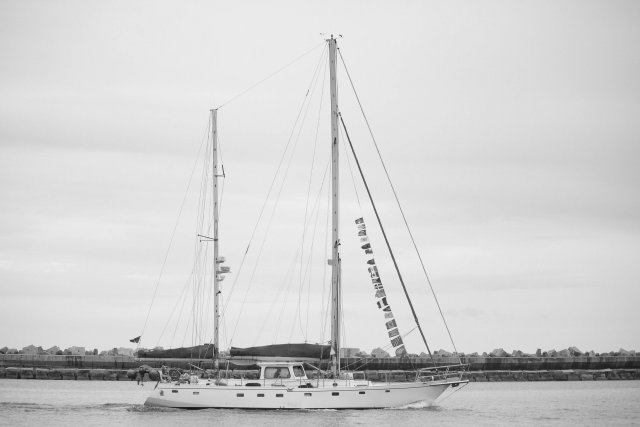
Epic adventurer Ralf Dominick arrived back in Durban on Wednesday afternoon in breathless overcast conditions concluding his 33 month odyssey circumnavigating the globe on his yacht Imvubu.


Dominick’s final leg was sailed from Reunion, which he departed towards the end of October, sailing in mostly stormy conditions over the 12 days it took to reach Imvubu’s hometown, the last three days the ocean was calm and windless. Stepping onto the moorings, a small group of family, friends and crew welcomed the intrepid adventurer home including his mother who saw him only once during his trip, briefly last year in May when he made a fleeting visit to South Africa. 


In the celebrations, he opened a bottle of champagne that he had received on his 50th birthday. The bottle had sailed around the world with him, waiting for a special occasion, smiling he stated, “It was well chilled through the Northwest Passage!”


The duo stopped off at 53 countries on their circumnavigation, including the gorgeous mythical Northwest Passage in August of last year. “Sailing my own vessel, I managed to stop off at a smorgasbord of places, be it cities, villages or islands. There were multiple visits to the USA and Canada; some territories have thousands of separate enchanting islands which I was able to explore!”


“Sailing under the Golden Gate Bridge at sunrise and past the Statue of Liberty at dawn are just two of thousands of my most memorable moments.”


Imvubu’s forestay was proudly decorated with flags from various countries he had visited as he motored into Durban.  


The valiant sailor departed from Durban in January 2010, heading down to Cape Town on her first voyage where the skipper tested the sea legs of his 53 foot Barens Seatraders. Asked why he named her Imvubu, which is Zulu for Hippopotamus, he laughs, “Well she is fat, large, ugly and extremely strong!”


Dominick enjoyed the company of a variety of crew throughout the journey, but bravely sailed a number of legs on his own.


Chatting about what he would like to do in the future, he comments, “Next year Imvubu and I are heading down to Antarctica, so I have a year to prepare for that journey. But I would love to do an Ocean Race, perhaps a Volvo in the years to come?”


Dominick was awarded the Royal Natal Yacht Club’s ‘Sailor of the Year’ for 2012 and also received the Gordon Burnwood Trophy by South African Sailing  and the Barton Cup by the Ocean Cruising Club for ‘the most meritorious ocean race or passage’ in 2011. 


Ralf Dominick concluded his phenomenal trip, entering the distinguished book of sailors how have successfully circumnavigated the globe.