Showing posts with label #ralfdomink. Show all posts

Tuesday, August 26, 2014

A wander around Washington DC

USA
Washington


Epic adventurer, Ralf Dominick who sailed around the world and recently travelled to Antarctica strongly suggested to me a stopover in Washington DC and following his advice, I did just that spending six days in the capital.


Dominick had spent a month in Washington living on his boat so he got to know the town extremely well. Home for me for the duration of the stay was in the historic district of LeDroit Park a short metro ride from majority of the sights.


As one of the first suburbs of Washington, LeDroit Park was developed and marketed as a ‘romantic’ neighbourhood with narrow tree-lined streets that bore the same names as the trees that shaded them. The colourful neighbourhood had a very distinct architecture with Victorian mansions co-existing with row houses that were all elegantly and brightly painted. My accommodation was terrible but the suburb certainly was fabulous and the local pub was well worth a stop, called the Boundary Stone Public House, it served great food and offered an array of locally brewed beers all on tap. A pint of DC Brau was certainly a memorable craft.


Every night after catching the last train out, wandering home I strolled past the century old Howard Theater and every night the red carpet was dressing up the pavement with limousines lining up outside waiting for their guests. The events changed nightly at the busy theatre from a glitzy CD launch by a famous hip-hop artist, to an awards evening to a rap artist concert. They were all by invite only and posters of a theatre performance being advertised was weeks away.


Each day I would venture into Washington, exploring the well-known sights. The capital for me was very monotone. All the sights, the buildings and monuments felt like it was one colour; marble-white certainly dominated the colour chart. But saying this, there was an air of excitement being in this ‘famous’ city.


I trawled the city stopping at all the main tourist attractions, saying hi to the massive statues of Jefferson and Lincoln, cruising around the manicured grounds on Capitol Hill, wandering past the heavily-secured small building of the White House, gazing heavenwards up at the Washington Monument that was under repairs from an earthquake in 2011 and pondered the meaning of war as I wandered through various war memorials dotted around the city.


The city was immaculate, with an almost Singaporean approach to litter, these was hardly any! Breaking up the monotone colour scheme were the cheerful Cherry Blossom trees. I had missed the Cherry Blossom Festival by a week but the tail end of the blooms was still a delightful treat. The daffodils were blooming marvellous, every single street had rainbow displays, if they were in pots, flowerbeds or planted neatly around traffic circles they certainly made a jolly impact.


The Smithsonian Institutions were great. I spent fat too much time exploring through the sculpture gardens, the National Air and Space Museum, National Museum of Natural History, National Art Gallery, African American History and Culture Museum, African Art Museum, United States Botanical Gardens and the information building nestled in The Castle – the only building in the vicinity that was brick coloured and not the antique colour of marble white.


The African Art Museum was interesting but I far more enjoyed the underground warren of art-clad corridors that took you into a maze of other gallery spaces. I landed up in the Arthur M Sackler Gallery and I relished the two exhibitions there, Chigusa and the Art of Tea a flavourful and insightful exhibition of the origins and traditions of tea in China and the Kiyochika: Master of the Night. This late 19th century Japanese artist Kobayashi Kiyochika paintings reflected the transformations of modernity around Tokyo before and after the great fire that wiped out the city.


My American culinary adventures went along the lines of when in Rome, do what the Roman’s do – this included a lunch at a MacDonalds where I sampled a Big Mac burger. After a full morning exploring through the National Museum of the American Indian, I dined out on a Native inspired menu. I sampled a delicious Wild Rice and Watercress salad accompanied by a snap pea and lotus root salad drizzled with aged sherry vinaigrette.


A moving highlight was spending time at the Pentagon’s 911 memorial. With all the conspiracy theories flying around about the tragic day, visiting this simple memorial on an un-crowded Sunday was still heartfelt. Over a decade on, the injured side of the Pentagon was still a construction sight with the beeps of construction vehicles interrupting the peaceful surroundings. 


A glistening black marble wall carved with the names of the people that lost their lives that day shadowed by a proud American flag wafting about, greeted visitors. To the right was a barren park with a few young trees starting their ascent in the hopes of shading the memorial. A knee high wall cupped the park and every couple of meters on top of the wall was a sign with a year engraved. Travelling across the floor of the park was a line that came up to meet the timeline spotted along the boundary. The timeline on the wall indicated the year that the 911 victims were born; the timeline began at 1998 and ended at 1930.


Rising out of the gravel, between the lines were a number of diving boards that looked out of place without a massive shimmering turquoise pool. On closer inspection, each statue had a small serenity pool situated directly under the overhang. At night, lights shone up through the water illuminating the statues in an eerie but beautiful manner.


The 184 diving boards shot off in two directions in a somewhat sporadic order. Chatting to a Pentagon Policeman that was lurking at the entrance to the park, he explained that the statues jutting towards the Pentagon were the lives lost on the plane and the statues facing away were in the Pentagon at the time of the impact.


Another encounter with a kind police officer happened at a deserted Metro station in the city late one evening. The young officer accompanied by a beautiful black Labrador was sweeping the area looking for anything out of the ordinary. Leo the Labrador and his partner worked for the bomb unit and Leo had recently returned from spending two years in Afghanistan. He was working the quieter late shift as he had just graduated from six months in rehab after all the action he had seen. A sad reality of war that this poor Labrador had been a part of.


A couple of evenings in DC were spent at the annual Filmfest DC. Being a frequent Durban International Film Fest goer, it was great to see how other cities put on festivals. Filmfest DC should be commended for its successful weeklong flurry of films. The venues were cleverly married up to the films that it was showing. I watched a French feature film, Gare du Nord at the French Embassy and a Danish thrilling who-dunnit, The Keeper of Lost Causes at a historic old theatre that had been converted into movie houses. All the staff at the fest were cheerful, engaging and helpful.


Most days before heading back to my accommodation to change into evening attire, I would take a breather from the overload of sightseeing. The famous patch of lawn stretching from Capitol Hill to the Washington Monument was a healthy shade of green and it became a hive of activity when everyone knocked off from work. The activities on the lawns were adorned with various mixed leagues ranging from American Football to soccer to softball and even a strict class of boot camp. Sitting on the benches people watching, a steady stream of runners and dog walkers would hustle past, dodging strolling tourists. Majority of the Capitol workers certainly were in peak fitness condition, in contrast to the lumpy tourists wandering around. 


Watching the sunset over the Capitol, the city of DC started to twinkle under lights, I got to see the magnificent sights under darkness. Certainly a memorable sight.


DC was fascinating, a wonderful adventure, I am glad that I got to explore the powerhouse of the Western world. Will I rush back there again? I would have to say it is a case of been there, done that and didn’t fancy acquiring the T-shirt.


Wednesday, December 5, 2012

Round the World Sailor, Ralf Dominick talks about the Northwest Passage

Imvubu meaning Hippo going through the Northwest Passage and meeting a local. Cartoon done by Lawrence Moorcroft from the Bluff Yacht Club


Royal Natal Yacht Club hosted Ralf Dominick recently where he shared tales to a packed room of sailors

Going to listen to the charming Ralf Dominick, you are in danger of acquiring a few stamps in your passport when he passionately shares tales of his circumnavigation on his yacht Imvubu.

Commodore for the Royal Natal Yacht Club, Richard Crockett, introduced the intrepid traveller as a free spirit, setting sail with no real plan of where he was going.

Manihi Atoll


Dominick stood before us smiling, explaining, “I am going to leave out the tropics as many of you here this evening have sailed in parts of it and a number of you here have sailed in company with Imvubu so you would know if I am exaggerating or lying.”

Continuing with a twinkle in his eye, he commented, “I am going to concentrate on the journey through the Northwest Passage, and it is not because I am boasting being one of only about 150 transits through this passage, but because no one here will know if I am exaggerating slightly.”

Dominick launched Imvubu on the 19 June 2009 at the Bluff Yacht Club, he chuckles, “I got my own back at the truck drivers. I blocked the road for half a day as she was craned from the yard onto a truck and transported to the launch site.”

Departing Durban on 2 January 2010, he sailed south to Cape Town where he packed up his boat with supplies for heading across the Atlantic. Waving goodbye to family, he left Cape Town on 21 February 2010.

Having spent close on a year cruising through the magnificent Caribbean islands, with Imvubu spending three months on the hard staying safe during the hurricane season, Dominick headed north. At the end of April they made their way up the East coast of America with the goal of making it through the magical Northwest Passage.

They stopped in at Washington DC, sailing right into the heart of the capital. Exploring the cultural melting pot that is the capital, Dominick stumbled upon the Rolling Thunder Rally that has a quarter of a million Harley Davidsons cruising through the capital. “After three hours, after watching thousands of HOGs go by, I left, mainly because I had a headache from the noise!”


Next was a stop in New York City, “Since 9/11 I found the residents to be a lot kinder than in previous visits.” he stated happily.


“One of the best naval museums I have ever visited was located at my next stop, in Mystic Seaport located on the Mystic River. They have over 35 boats on display including an 1820 whaling ship. The Charles W. Morgan is the only surviving wooden whaling ship in America. It was a treat to visit.”


At Portland, on the coast of Maine, gearing up for the expected freezing conditions further north, another 20,000BTU of heating was added to the 5,500BTU already installed on Imvubu.

From the USA East Coast the journey continued on to Nova Scotia, Canada and onwards to Newfoundland. “A number of the small towns are slowly dying due to the moratorium on Cod fishing. In fact during the 1950’s the government had a forced resettlement program to consolidate many of these settlement. Most adults now work on the oil fields in Alberta while the youth are moving south where life is a lot easier, so in some places it felt like a ghost town.”

Gros Morne National Park Newfoundland Canada


“I sailed through a fjord that was 200m wide and was experiencing the worst fog for many years. In the gaps we managed to see the sheer cliffs that surrounded us with tumbling waterfalls cascading into the cold water. Yet another exquisite memory!”


Ralf's favourite pic of an Iceberg. He didn't dare get to near it in-case he dislodged some of the ice.
While in Newfoundland Dominick made the decision to commit himself and his crew to the Northwest Passage:  “I must say, it was the case of right place, right time, right boat and the crew was solid!”

Newfounland Huge Fjord


In 1497, the first recorded expedition to find the mythical Northwest Passage, was undertaken by John Cabot. For the next three centuries there were many expeditions to locate this passage. During the Napoleonic wars the quest for the passage waned. However in 1819, due to reports by whalers that the ice was retreating, interest in finding the passage was renewed. The most famous failure was in 1845 when Sir John Franklin, with his two vessels the Terror and the Erebus, failed to return. Subsequent relief expeditions, launched at the behest of Lady Franklin to determine the fate of John Franklin, are credited with having discovered an impractical ice bound passage by dog sled. John Rae, an employee of the Hudson Bay Company, while on a dog sled expedition in this area is now generally credited with having discovered a navigable passage through the Franklin Strait into the Beaufort Sea.

The first vessel to actually transit the North West from Arctic Circle to Arctic Circle was Roald Amundsen in 1903. The next transit was some forty years later by a Canadian Police cutter skippered by Henry Larsen. By the end of the 2010 season the Scott Polar Research Institute at University of Cambridge had recorded 143 transits by 99 different vessel.

Dominick was approximately the 150th entry into the esteemed list that completed a transit from Arctic Circle to Arctic Circle through the Northwest Passage. Imvubu was the first South African Vessel to have completed the transit.

In 2011, the window of opportunity was better than previous years as the temperatures and ice seemed a lot kinder than in previous years, giving Imvubu and Dominick a gap of six weeks to make it through.

Dominick stopped off at St John, Newfoundland, the last significant town before getting to the other side of the world, to prepare the vessel for what lay ahead.  “There are many details to be considered such as a solution for preventing the engine cooling water intakes from freezing, preventing condensation from forming on windows, provisions for a year and of course charts for the region.”

“You might have heard of St John, the wreck of the Titanic lies some 600km south east of this town. The distress call from the Titanic was picked up at Cape Race, 140km south of St John's, where the Canadian Marconi company had built a station eight years earlier.”

“Before departing St John, I went to collect our charts that I had ordered but they hadn’t arrived. The charts were a vital ingredient for the next leg. We needed the charts! The owner of the company promised me that at the next stop at Cartwright in Labrador, he would have the charts there; they would be at the small airport. We got to the airport a few days later and went to meet the plane, but there was nothing. The pilot defensively even suggested we search the plane, there really were no charts. I contacted the airline and found that the plane that they were on had been diverted due to the weather. So asking around I found a lady who lived in the town where the plane was and her brother was unemployed, so he got in the car and drove the charts up, a return trip of 16 hours. Arriving at 1am, we gave him a cup of coffee, a thousand dollars and then sent him on his way a few hours later.”

The plan was to sail 2,000 miles northwards before turning westwards into Lancaster Sound, which marks the start of the actual passage. A 100 miles south of the turning point they sailed past a tender floating upside down. “It didn’t sit right as it clearly belonged to a yacht and there weren’t too many yachts around so we pulled it on board and contacted the coast guard. “The coastguard requested that we divert to Pond Inlet, a small hamlet in the high Arctic, to deliver the salvaged tender so that they could investigate its origins”.

Meeting the Coast Guard, meant that the planed route altered slightly with a dogleg  down to Pond Inlet, the coast guard on the other hand made sure that there was sufficient diesel fuel available for Imvubu.

On 20 August the direction altered for the first time in ten days, with Imvubu now following a path in a westerly direction. On 24 August, the South African vessel reached her highest point north, with the co-ordinates of 74°19’N, the wind was averaging 40knots and the temperature was 2.5°C.

They turned down to Cambridge Bay where they anchored to refuel. While they were ancored in the bay, Eskimos were shooting at Narwhals, small whales with a single tusk or the mystical unicorn whales. “It was a surreal Wild West situation, after refuelling with 500 litres of jet fuel, the only fuel they had in Cambridge Bay we were at anchor and had bullets whistling past us. It didn’t look like the locals were effective hunters as the bullets were almost hitting us and not the whales!”


The next encounter Dominick had with the locals was at the next settlement of Tuktoyaktuk as a guest at the local school, “I was invited to the school when the new teaches were being introduced. On one of the walls there was a huge sign in English advertising that they should eat more whales because they were good for you! The sign went into great details, talking about the fat content and what it did for you! Fascinating reading.”

Continuing, “This is where I tried whale blubber; I have to admit it wasn’t very tasty. Somewhat how one would imagine it to taste like!”, “a local Inuit hunter however gave me two freshly bagged brown speckled geese, that made a superb potjie”.

The door started slamming on the adventurer, with the pack ice moving in. He made his way through the Bering Strait sailing between Russia and across the way, the tip of America, leaving behind the Arctic Circle.  He made it to Nome, Alaska surfing in in early September, 164 miles from Siberia and just under 2,000miles from the North Pole. Nome is renowned for gold mining and Dominick met a man who generously gave him two nuggets as mementos from Alaska.


A sign post in Nome, Alaska


“I read in the Nome Times that when the cartographer was mapping the area, they hadn’t named the Cape so he simply wrote ‘? name’ down on the map. When the maps got back to the United Kingdom, the chap officially drawing them up read it as C. Nome which promptly became Cape Nome and the name stuck and that is how it has stayed!”

“Crossing the Bering sea we got hammered although it could have been much worse and made it into the safety of False Pass in the Aleutian Islands with hours to spare before the next big storm system arrived”.

When the weather cleared Imvubu pushed on, passing steaming volcanoes, “There are 36 active volcanoes in Alaska, the most anywhere in the world located in one country! As we were sailing on a relatively calm day through the Kupreanof Straits a rocket launch took place from the Kodiak Space Centre on the other side of Kodiak Island”.

The intrepid traveller sat out yet more bad weather in Yakutat Bay on the eastern side of the Gulf of Alaska, here he joined another yacht that had also transited the North West Passage and the two of them waited through gale force winds. “We followed a number of fishing vessels heading out but encountered an unexpected low pressure system with storm force winds and mountainous seas, clearly we didn’t go very far and turned around and ran for shelter.”

“In desperation I spoke to the met guys and their response was that they were unable to forecast the weather because every few hours the weather was changing dramatically.”

In the early hours of the next morning there was a slight break in the weather and Dominick decided this was the gap. Saying a quick goodbye to this fellow yachtsman, who was not at all convinced that there was a break, he left the dock and sailed further down the coast, escaping the weather in a few more coves but made it into the safety of the Alaskan Inside Passage.

“When I arrived at Juneau Alaska I could celebrate as I had made it through the Northwest Passage and got out of the high latitudes before winter set in!  Although I was now through the worst I knew there was still a hard slog ahead to make my way down the North American west coast in winter.”

“My friend got stuck in Yakutat for a further three weeks and by the time he got into the Inside Passage the season was too far advanced and he had to give up and spend the winter at Sitka.”

Showing us a number of gorgeous images, he pauses stating, “Of the thousands of photos that I took on the trip, this is my favourite. Blackstone Glacier was just exquisite.”


Asked if he was ever scared, he smiles, “I used to fly jets for fifteen years so going from a sport of flying at a speed of six miles a minute to sailing  six miles an hour, I would think I coped under the pressures that arose. And I have to say that the boat was superb in all the conditions!”


Concluding he questions, “Doesn’t anyone want to know about the fishing and the fish? The places I visited were not only picturesque but heavenly on the taste buds. I ate like royalty, everything from crayfish to salmon to cod. You name it, I sampled it. I would have to say my best fish would have to be Arctic Char which was just delectable.” 


Imvubu is currently being prepared for her next odyssey when he plans to head down south to Antarctica and then up the east coast of South America before crossing to Europe However, he is plotting to return to Alaska… in summer and not with his boat.

The inspiring story of Ralf Dominick’s lifelong dream to circumnavigate the globe plants seeds for those with itchy feet and a desire to travel to a number of incredible options that lie waiting to be discovered.

Friday, November 9, 2012

RNYC Sailor of the Year returns to Durban


Royal Natal Yacht Club
RNYC Sailor of the Year returns to Durban
Round the World


Epic adventurer Ralf Dominick arrived back in Durban on Wednesday afternoon in breathless overcast conditions concluding his 33 month odyssey circumnavigating the globe on his yacht Imvubu.


Dominick’s final leg was sailed from Reunion, which he departed towards the end of October, sailing in mostly stormy conditions over the 12 days it took to reach Imvubu’s hometown, the last three days the ocean was calm and windless. Stepping onto the moorings, a small group of family, friends and crew welcomed the intrepid adventurer home including his mother who saw him only once during his trip, briefly last year in May when he made a fleeting visit to South Africa. 


In the celebrations, he opened a bottle of champagne that he had received on his 50th birthday. The bottle had sailed around the world with him, waiting for a special occasion, smiling he stated, “It was well chilled through the Northwest Passage!”


The duo stopped off at 53 countries on their circumnavigation, including the gorgeous mythical Northwest Passage in August of last year. “Sailing my own vessel, I managed to stop off at a smorgasbord of places, be it cities, villages or islands. There were multiple visits to the USA and Canada; some territories have thousands of separate enchanting islands which I was able to explore!”


“Sailing under the Golden Gate Bridge at sunrise and past the Statue of Liberty at dawn are just two of thousands of my most memorable moments.”


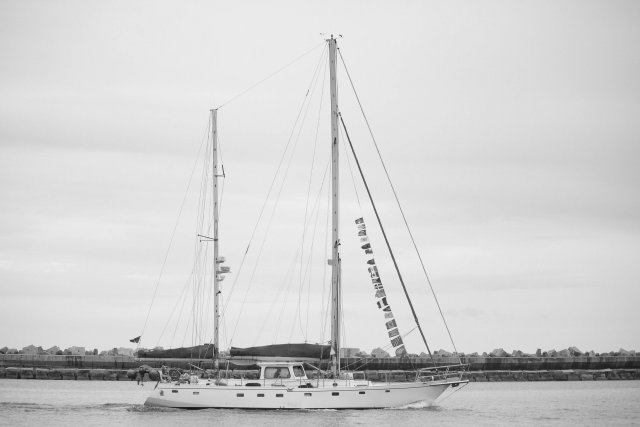
Imvubu’s forestay was proudly decorated with flags from various countries he had visited as he motored into Durban.  


The valiant sailor departed from Durban in January 2010, heading down to Cape Town on her first voyage where the skipper tested the sea legs of his 53 foot Barens Seatraders. Asked why he named her Imvubu, which is Zulu for Hippopotamus, he laughs, “Well she is fat, large, ugly and extremely strong!”


Dominick enjoyed the company of a variety of crew throughout the journey, but bravely sailed a number of legs on his own.


Chatting about what he would like to do in the future, he comments, “Next year Imvubu and I are heading down to Antarctica, so I have a year to prepare for that journey. But I would love to do an Ocean Race, perhaps a Volvo in the years to come?”


Dominick was awarded the Royal Natal Yacht Club’s ‘Sailor of the Year’ for 2012 and also received the Gordon Burnwood Trophy by South African Sailing  and the Barton Cup by the Ocean Cruising Club for ‘the most meritorious ocean race or passage’ in 2011. 


Ralf Dominick concluded his phenomenal trip, entering the distinguished book of sailors how have successfully circumnavigated the globe.


Monday, October 29, 2012

Chatting to Epic Adventurer - Ralf Dominick

Royal Natal Yacht Club


RNYC Sailor of the Year returns to Durban
Round the World


To have your name etched in the distinguished book of sailors who have successfully circumnavigated the globe, the Royal Natal Yacht Club, is eagerly awaiting their ‘Sailor of the Year”, Ralf Dominick to arrive being the latest entry into the Round The World Club. 


Dominick, who launched his boat in Durban, tested her sea legs on a passage down to Cape Town before heading off in February 2010 on his epic voyage. His first adventure took him up the West coast of Africa before attacking the Atlantic Crossing, taking him to St Helena in the South Atlantic. After he spent time sailing around the islands of Central America, his adventures took him further north “I sailed into New York, past the statue of Liberty at dawn. The sight was truly remarkable.”

NASA Photo: The Godspeed Sailing Ship and Statue of Liberty

Northwest Passage

Dominick is not only entering into an elite club of sailors when he arrives this week in Durban but is one of about a 150 people to have sailed through the fabled Northwest Passage. “When asked what my highlight is so far, indeed it is a difficult question to answer as it depends on which facet is considered but overall it would have to be arriving in Nome in Alaska and realising that I had got through the Northwest Passage unscathed.” 

The sailboat, named the Belzebub II, will be the first boat other than an icebreaker to try to travel a challenging route through the Northwest Passage.
Pictured here is Belzebub, the first monohaul to sail through the Northwest Passage


The Northwest Passage is the sea route through the Arctic Ocean along the Northern Coast of North America.  The intrepid adventurer lists three memories from this leg of his voyage, “Drifting in front of the Blackstone Glacier in Prince William Sound on a perfectly clear and still autumn day, the incredible fjords, mountains, scenery and hospitable people of Newfoundland and the Alaskan Inside Passage from Cape Spencer to Ketchikan is just spectacular. To have been able to witness these scenes for me is just completely humbling.”

 Vessel Cloud Nine sailing through the Northwest Passage Pic by David Thoresen

Dominick comments, “Sailing under the San Francisco Golden Gate Bridge at sunrise was equally a special moment in my trip.”

Golden Gate Bridge - San Francisco

His route then took him down the west coast of the Americas, down to Mexico where he then did his longest single stretch at sea, the 16 day leg from Cabo San Lucas in Mexico to Nuku Hiva in the Marguesas in the Pacific where he completed 2,700 Nautical Miles. 

Marquesas is located in Pacific Ocean

The odyssey vehicle, a monohaul yacht, named Imvubu which is Zulu for Hippopotamus. Imvubu is a 53 foot Barens Seatraders, built for adventure and going to out-of-the-way places which her skipper certainly has tried and tested. 

The Commodore for the Royal Natal Yacht Club, Richard Crocket enthused, “I am not sure who the last RNYC member was to complete a circumnavigation, but whoever it was it was a long time ago.”


Departing last weekend (Saturday 27 October) from Reunion, Dominick is expected in early November in his hometown. Dominick shares, “The one lesson I did learn on this trip was the amount of maintenance required to keep a boat going on an extended voyage. Imagine the result of packing all your belongings into a shipping container including your household appliances, motor vehicles and lawnmower, adding a liberal dose of salt water and shaking for two years. Saying that, I am extremely lucky that I didn’t suffer any mayor mishaps along the way.”


The local sailor has spent the last two years and nine months sailing majority of the time solo, with friends and willing crew joining him for a variety of the legs. His challenge is now to settle back into everyday life.

Asked what lies ahead, he says “Catch up with family, friends and business; renew all the things that have expired such as drivers licence, TV licence and pilots licence; refit the boat and set sail for Antarctica in November 2013.”


Durban welcomes the intrepid pair, Imvubu and her skipper Ralf Dominick when they complete their circumnavigation of the globe.