After a crazy night with gusting winds and awkward waves smacking
the boat, we saw land. The island was a welcome sight after five days of
sailing.
Topaz had made good time to get to the southern tip of
Madagascar. We had averaged 8knots with the motor hardly being turned since departing
from Reunion. As we mounted the shelf just off Madagascar, we got blasted by
heavy winds and large rolling swells. Topaz was fitted with two autopilots, one
for light winds and gentle weather nicknamed Chillo, the other, Loudo, was used
for more challenging conditions.
On our approach to Madagascar, Loudo went on the blink which
meant that we had to hand-steer. Rob Ferenczi, the owner skipper of Topaz navigated
the shifts as Jen, the third crew member was really hesitant to steer. The
shifts were divided up into two hours between Rob and myself with Jen having to
wake up every twenty minutes to make sure we were on track and weren’t about to
smack into land or any boats.
The winds were consistent, that we were grateful for. At
the start of my 2am shift, the winds had built to around 45knots hitting us on
a starboard tack at a close reach. The waves drenched me from two sides, the
fresh saltwater working wonders keeping me refreshed and alert. The sound the
water made as the waves lurched up was rather eerie but kept me company in the otherwise
silence of the dark night.
An exhausted Jen poked her head up from her bunk
20minutes into my shift enquiring about how I was doing, at that point a rogue
wave rose up from behind and broke on me, the freak wave then continued its
path, filling up the companion way. What felt like the entire ocean disappearing
down below, I remember screaming for my skipper, shouting, “Robi, the waves are
coming from behind!”
Within a split second, Rob was up and assessing the
damage with Jen. The force of the wave had hit the engine block and diverted
into my bunk, soaking parts of my bed. The floor in the galley was drenched but
miraculously that was the only damage. Jen quickly evacuated all my electronics
and books, giving them a wipe over, she put towels down and blankets to soak up
the water on my bunk.
The two of them worked quickly and efficiently, clearing
up the water. Rob came up onto the deck and checked if everything was all
right. A petrol canister had been flung across the deck and was leaking fuel close
to me. He tied it down and made sure I was ok.
At the end of my shift, I uncurled my fingers and white
knuckles from Topaz’s steering wheel and disappeared down below following the
wave’s path of destruction. Miraculously, besides a wet floor, wet bunk and a
wet me, the only thing that didn’t survive was my small camera. For a few
minutes I just stood in the galley, flexing my fingers getting the blood
circulating and starting to relax. I collapsed into my bunk, too tired to mind
the damp surroundings.
The next time I awoke, the conditions were remarkably
pleasant, the bad weather seeming like a distant and bad dream. The world
became lighter as daytime dawned warding off the evil weather. As the world got
lighter, we could see land. The remoteness of the island was a stark contrast
to the blueness of the ocean.
That day we sailed on the shoulder of Madagascar, finally
that afternoon we got to our destination. A secluded, sheltered bay that Rob
had found on a blog from some fellow sailors, this was to be our home for the
next four days.
We opted not to go onto land as we hadn’t cleared in so for four days we were
anchored off the southern tip of Madagascar, so close to land yet so far. We
dropped Topaz’s anchor, cracked open a beer and watched the most magnificent
sunset with small local fishing vessels making their way home.
Our time off Madagascar was spent repairing autopilots
and sails. Rob spent two days in the lazarette sorting out Loudo while Jen and
I practised our sewing and patching, fixing the genoa that had blown out in the
bad weather the night we sailed over the shelf. We could see a village from
where we were anchored, a simple untouched hamlet. Local fisherman sailing on
handmade dhows stopped by regularly and we attempted to trade with them. Jen
was elected as our negotiator and did a sterling job communicating with the Malagasy
fisherman.
The locals weren’t shy to ask for things, coming up right
next to Topaz and getting an eyeful of what was on offer on the deck, one lad
kept urging us that we give him the dugout canoe that Rob had been lovingly
sailing with for over 15years. He was disappointed with our constant negative
responses. They mostly wanted clothes and fishing gear and Jen worked her magic
scoring five lobsters, and a green coconut as a trade. The Topaz trio gave away
some long life cheese that had been on the boat since Indonesia and witnessed
two vessels’ occupants tasting this foreign food. The cheese didn’t go down
well but they fortunately had good humour about their taste buds being
assaulted with this new flavour.
While we were anchored there, two of the three boats we
were sailing in convoy with also took refuge in the bay. The Canadian family
sailing on Viatrix arrived the day after we arrived and the American family
sailing on Azimuth arrived on the third day. Viatrix had blown their main sail
while Azimuth had had some engine trouble. All three boats were busy with running
repairs.
We took Topaz out for a test drive, after Rob was happy with the job he did on
Loudo. He had spoken to a technician using the satellite phone and also had
several emails in regards to what the problem was and a few suggestions how to
solve it. We raised the anchor and took Loud for a test spin, literally. Going
around in circles, this way, that way, all the while a look of puzzlement and
hope masked my skippers face. During our test drive the weather deteriorated,
with the winds and waves flying through the opening of the bay. The decision
was made to motor out to an island that was just on the horizon that promised
better shelter. Viatrix and Azimuth quickly
followed us. The island offered a small reprieve from the wind but the rolling
swells didn’t let up. Viatrix snuggled up alongside us but Azimuth opted to
retreat back into the bay and ride out the bad weather.
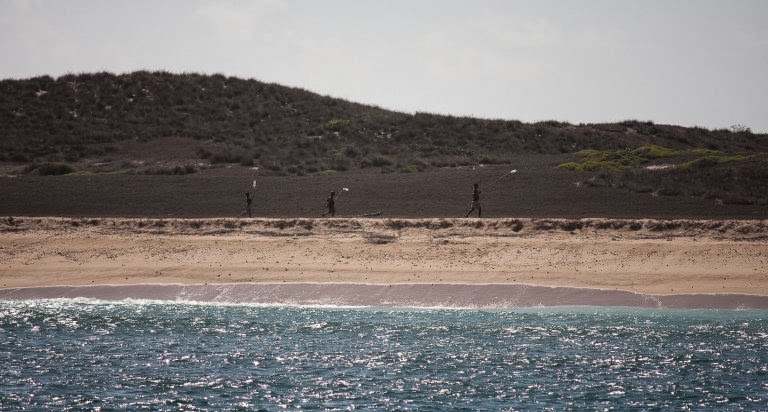
The island in front of us was fascinating. No visible
signs of any village but a number of merry men kept appearing. Their clothing
seemed minimalistic but their hearts full. They danced and shouted from the
beach. As the sun began to set, the whole band of merry men sat on the beach
and just observed us. We began to refer to the island as Mad Men Island and
started weaving stories about how this was where the insane Malagasy men landed
up.
After a rolly night, we woke up early and raised the
anchor. Next stop the African continent. As the sun rose we set off, waving goodbye
to Viatrix who still needed a few hours to repair their main. As soon as we got
out from the shelter of the island, the wind picked up, we set our sails and glided
homewards.
Again, the wind gods were kind giving us a generous amount
that allowed us a smooth sail towards South Africa. Our shifts were pleasant,
with not much needing to be done as the winds were consistent and didn’t swing around.
We indulged on lobsters each evening and didn’t have to trawl for fish.
Rob kept a constant eye on the weather; we knew that we
were going to get hit by a front that was moving up the coast and a day out
from South Africa we had to make up our mind if we were going to hole up in
Richard’s Bay or batter our way down to Durban. That night, we had a list of
what to do as and when the front approached; we put two reefs in the main in
preparation while it was still light. Like my mate Chris Sutton states, we knew
it was going to blow the spots off the Dalmatians.
The waiting game ensued; we motored as there was hardly
any wind that evening, the calm before the storm. I watched with interest and
fear as the clouds moved across the dark sky, was this the front? Two hours
after the bewitching hour, I began my watch. I kept my eyes peeled at the stars
as they constantly disappeared by large masses of clouds that flew across the
sky. The wind began to pick up, as did my heart rate. Our instructions were to
wake Rob when the wind built to over 15knots, I watched the wind build, 7, 8,
9, 10. The numbers kept ticking up. I kept repeating the Topaz quote, “Give it
a minute, give it a minute, give it a minute!” As the wind consistently blew
near 20knots, I went to wake Rob.
He came up, surveyed the conditions, looked at the wind.
We cut the engines and with the staysail, we surged forwards towards the
building front. He then disappeared below, giving me instructions to wake him
if the wind built up more. I nodded wide eyed, certain he could hear my heart
beating above the sound of the gusting winds. No sooner than he disappeared the
wind gusted up and we heeled over dramatically. I responded as quickly as I
could, letting out the main sail to depower, then moved to the starboard side
of the cockpit to let the staysail out. I had one hand on the deck as I
generously let the sail out. Water rushed along my knuckles as I stared into
the abyss of the water, dark then white patches of water rushed past my gaze as
thoughts ran wild in my head.
If Topaz went over, I had worked out what to do. The
chess game against the weather had been plotted and I knew what my escape plan
would be. What seemed like ages was most probably only a minute or so, Rob was
up alongside me bearing away so as not to be hit by the full force of the wind.
For the remainder of my watch, we got pummelled by the waves as they crashed
over Topaz.
The wind instrument at the top of the mast linked to the
panel instrument had blown off in the first onslaught of wind, so we had no idea
what the speed was or the direction of the gusts. The last speed I had seen was
46knots. Loudo handled the conditions perfectly and for that I was ever grateful.
Jen took over and Rob thankfully made the decision to heave to, stalling us in our progress. The difference from slamming into the weather to bobbing around in the storm was unbelievable. It was tranquil almost as we floated harmlessly in the Indian Ocean.
Daylight dawned by the conditions were still terrible. The following day was an unpleasant sail as the bow
smashed into countless waves, and the deck was sprayed with saltwater. Rob
decided that we would make our way to Richard’s Bay and wait for the weather to
clear. We slowly lurched forward, making our approach to Africa. As the day
drew to a close, we got our first glimpse of land. Green green land. Getting
closer, the lights began to twinkle as darkness fell on Richard’s Bay.
The Topaz trio made their way, passing anchored tankers
waiting to enter the port. We meandered into the bay, floating past a bow of a
tanker that had found its demise on the shores of Richard’s Bay. A reminder
that we should respect the ocean, the winds and a memento how quickly things
could change.
The time was nearly ten pm when we rafted alongside a
yacht. The odyssey on Topaz had drawn to a close. The date was Thursday 5
December, a momentous day. An auspicious day. A historic day. The day that I
had sailed to Africa. The day that Nelson Mandela had died.